Kräuterlikör and Kruidenbitter: Northern Europe's Herbal Liqueurs
Kräuterlikör in German and kruidenbitter in Dutch name the same northern habit: a strong spirit steeped with herbs, roots and spices, drunk neat and often in one go. Jägermeister is the bottle most people know; the rest of the family is smaller and more local, and some of it is much older.
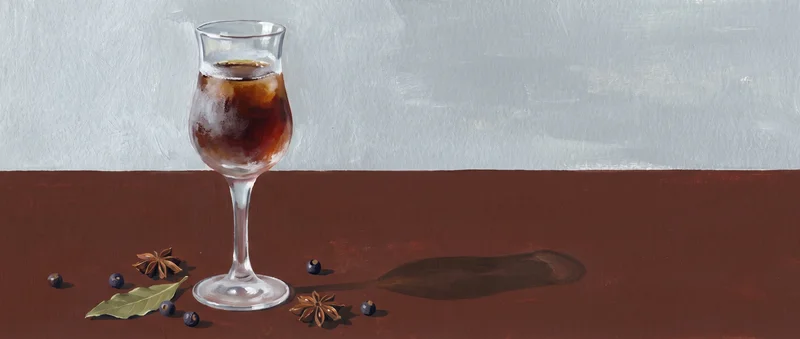
How is a Kräuterlikör different from an amaro?
Less than the two names suggest. Both are herbal liqueurs made by steeping botanicals in spirit and sweetening the result, and Jägermeister is often filed with the amari. The difference is geography and custom more than recipe: the Italian bottles are usually sipped slowly after a meal, while the German and Dutch ones are more often poured ice cold as a short glass or emptied from a single-serve bottle.
Is a Kräuterlikör the same as cocktail bitters?
No. Cocktail bitters are a seasoning used a few dashes at a time, and nobody drinks a glass of Angostura. A Kräuterlikör is a liqueur meant to be drunk. Underberg sits closest to the line: it is sold in a single-serve bottle and bottled at 44 percent, but that bottle is still emptied as a drink rather than dashed into one.
Which German bottles define the style?
Four cover most of it. Jägermeister, created in 1934 from 56 botanicals and bottled at 35 percent, is the one with the widest reach outside Germany. Underberg has been made since 1846 and comes in its single-serve bottle. Kuemmerling, also single-serve, is led by anise; Hugo Kuemmerling settled the recipe in 1938. Killepitsch is a Düsseldorf liqueur from the 1950s, dark and warmly spiced, at 42 percent.
What is Berenburg, and what is a kruidenbitter?
Kruidenbitter is the Dutch name for the category, and Berenburg is the Frisian version of it: grain spirit steeped with herbs, juniper and bay among them, at around 30 percent. The style takes its name from Hendrik Beerenburg, an Amsterdam spice merchant. Sonnema has made it in Dokkum since 1860, and Weduwe Joustra bottles another. On the island of Texel, Juttertje uses fourteen herbs and spices and is said to be named after the beachcombers who drank it to warm up.
Where does Unicum fit?
Unicum is Hungarian, made by the Zwack family since 1790 from more than forty herbs and spices and aged in oak. It pours near black at 40 percent and is more bitter than the German bottles, so it belongs to the same family as a Central European cousin rather than a northern one.
How are they served?
It depends on the bottle. Jägermeister, Killepitsch and Berenburg are drunk ice cold: Jägermeister's own tap machines hold it at minus eighteen degrees, Killepitsch comes straight from the freezer, and Friesland drinks its Berenburg cold. Underberg is the exception, taken at room temperature and in one go from its single-serve bottle. They also work long, and the site's serves for this family are the Jäger Mule, Icy Killepitsch, Kuemmerling Lemonade, Sonnema Sour, Texel Warmer, Berenburg met Sinas and Zwack and Soda, plus Underberg on its own.
Explore more
Other Guides
Amaro Guide: Italian Bitter-Sweet Liqueurs
Amaro: the main Italian styles, how each is drunk, the essential cocktails, and which bottles to try first.
Italian Aperitivo Guide: Campari, Aperol and Beyond
Italian aperitivo: Campari against Aperol, the Negroni and the Spritz, and how the hour is kept at home.
Fernet Guide: The Bartender's Handshake
Fernet: the most mentholated corner of the amaro family, why bartenders drink it, and the cocktails built around it.